Digital Spanish Graphic Novels: Inside the Señor Wooly E-Reader

Published onMar 02, 2021 • • ViewBooksblog posts
For years, I refused to make digital versions of our Spanish graphic novels.
Juan Carlos and I had put too much work into the books to turn them into PDFs. The artwork, the page turns, the experience of holding the book in your hands... I felt like too much would be lost.
Then the pandemic happened.
Suddenly, teachers needed ways to get books in front of students who weren't sitting in the same classroom. We started hearing the same request over and over: Can you please make the graphic novels digital?
So we decided to try. But we made one decision right up front:
The digital books couldn't just be watered-down versions of the physical books. They had to do things the physical books couldn't do.
That decision led us to build our own digital graphic novel reader from scratch.
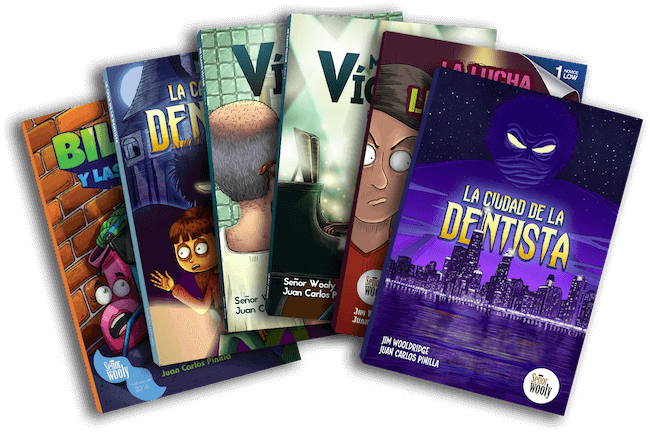
A Spanish graphic novel e-reader built around the artwork
The first thing we wanted was simplicity.
Graphic novels are visual. We didn't want the screen buried under buttons, menus, scroll bars, and other interface clutter. So we built a minimalist e-reader that gets out of the way and lets the illustrations take over the screen.

Read by page or by panel
Students can read an entire page at once, just as they would in the physical book. Or they can switch to Panel View and move through the illustrations one at a time.
Some students prefer seeing the composition of the full page. Others benefit from having only one illustration and one small chunk of Spanish in front of them at a time.
Panel View is also great when you're projecting a graphic novel for the whole class. Instead of asking students to figure out which speech bubble you're talking about, everyone is looking at the same panel.

A contextual Spanish glossary
This was one of the features I was most excited about.
Students don't have to flip to the back of the book or open another tab to look up unfamiliar Spanish. With one click, they can see the translations they need for the specific page or panel they're reading.
And the glossary is actually contextual.
If a word has multiple meanings, students see only the meaning that applies to the sentence they're reading.
It's a small distinction, but for a beginning Spanish student trying to stay inside a story, it makes a huge difference.

Professionally recorded Spanish audio
Every line of dialogue is professionally recorded, almost entirely by native Spanish speakers.
Students can listen while they read, replay a line when they need to hear it again, and connect the written Spanish on the page with spoken language.
The goal isn't to turn the graphic novel into an audiobook. It's to give students another layer of support whenever they need it.

Four Spanish proficiency levels in every graphic novel
This is still my favorite feature.
We rewrote the dialogue of the graphic novels four times.

And I don't mean that we ran the same text through some formula that changed a few verb tenses.
We went line by line through each story and asked what that moment needed at each proficiency level. At the lower levels, we stripped the Spanish down to its essentials. At the upper levels, we could add more detail, texture, and linguistic complexity.
The story and artwork stay the same. The amount and complexity of the Spanish change.
That means the same graphic novel can be accessible to students at very different stages of learning Spanish. A beginning student can read the story without being buried in language, while a more advanced student can read a richer version of that same story.
The best scenario? Use both.
For all the things we love about our e-reader, we never stopped believing in physical books.
In fact, large-scale research comparing print and digital reading has found a small comprehension advantage for reading on paper. And there's something wonderfully focused about putting an actual book in a student's hands. No screen. No tabs. Just the artwork, the Spanish, and the story.
Does that mean I'm poo-pooing our own e-reader? Not at all.
The e-reader can do things a physical book simply can't. Students can switch proficiency levels, hear professionally recorded audio, look up words in a contextual glossary, and move through the story one panel at a time. Those tools can make a story accessible to students who might otherwise struggle to read it.
So for me, the ideal isn't choosing one over the other. It's using each one for what it does best.
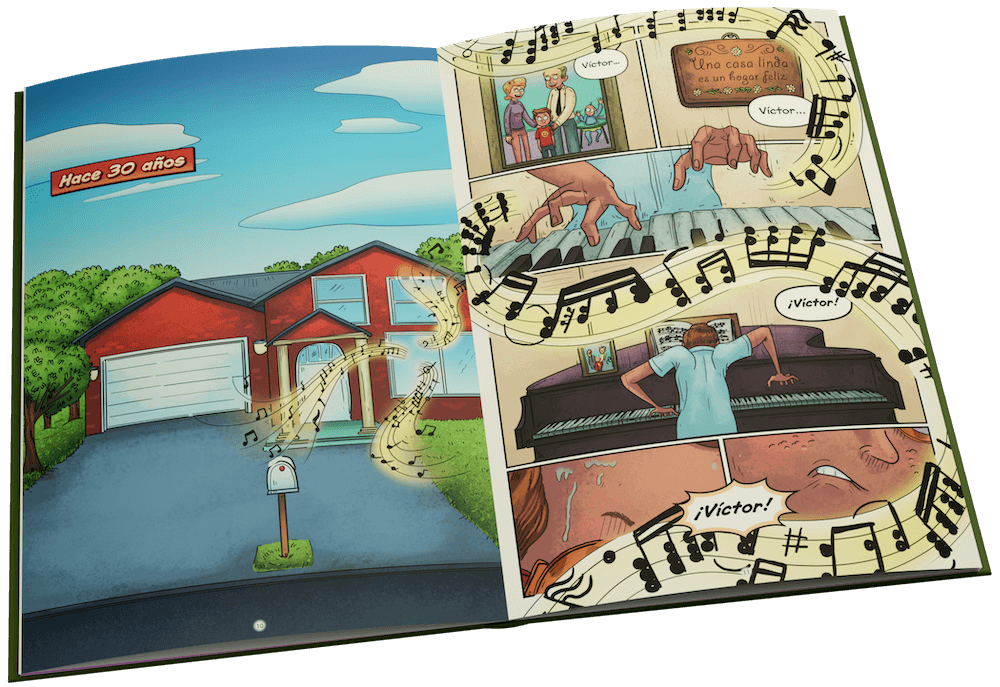
Use the e-reader when students need additional language support, when you're projecting a story for the class, or when you want different students reading the same story at different proficiency levels.
Use the physical books for sustained independent reading, classroom libraries, class sets, and those moments when you want students to put the screens away and simply get lost in a story.
Or better yet, use both.
Read Wooly graphic novels
Choose the format that works for your classroom, or use both.
Shop physical books → Explore the e-reader →

