Why Graphic Novels Work So Well for Beginning Spanish Readers

Published onMay 02, 2019 • • ViewBooksblog posts
Graphic novels are incredibly hard to make. They take forever to write and illustrate, and they’re ungodly expensive to produce.
So why do I keep making them?
Why not just write traditional Spanish readers? The market already exists. Teachers know how to use them. No one needs to be convinced of their value.
I keep coming back to graphic novels because I think they offer something uniquely valuable to beginning Spanish readers: the artwork carries part of the burden of comprehension.
When students don’t understand every word, they can still understand the story. And that changes the experience of reading in another language.
For me, that advantage really comes down to two things.

1. The sand bank
It’s easy to forget how exhausting reading in a second language can be for novices.
A student encounters two or three structures they don’t know, and suddenly they’ve lost their sense of place in the story. Now they have three choices:
A) Go back and reread.
B) Keep moving and hope things eventually make sense.
C) Give up.
That’s why I make sure my graphic novels contain at least a few scenes with little to no text on them.
I call these dialogue-free pages “sand banks.”
A sand bank is a place where a student can catch their breath and think, “Okay, I was a little confused by that last scene, but now I know what’s going on. I’m ready to keep reading.”

A “sand bank” example from Billy y las botas: the story keeps moving, even though there’s almost nothing to read.
A graphic novel can give students an intermittent brain break from the language without giving them a break from the story itself.
2. Increased noise tolerance
Every reader has a certain amount of “noise” they can tolerate.
By noise, I mean the words and structures a reader doesn’t understand. If there’s only a little noise, we can usually move right past it. But eventually we hit a point where there are so many unknowns that we lose our sense of what’s happening.
That threshold is different for every student. It changes with proficiency, background knowledge, environment, and especially how interested they are in the story.
Graphic novels can raise that threshold because the words aren’t doing all the work.

Even when some of the Spanish is unfamiliar, the artwork gives the reader a tremendous amount of information.
With so much of the story being communicated through illustrations, students have far more context for making sense of unfamiliar language.
They can see where the characters are. They can see their expressions. They can see what just happened and often predict what might happen next. All of that information helps students make reasonable guesses about language they haven’t acquired yet.
And when students have a strong sense of what’s happening in the story, they’re much more willing to tolerate a sentence they don’t completely understand.
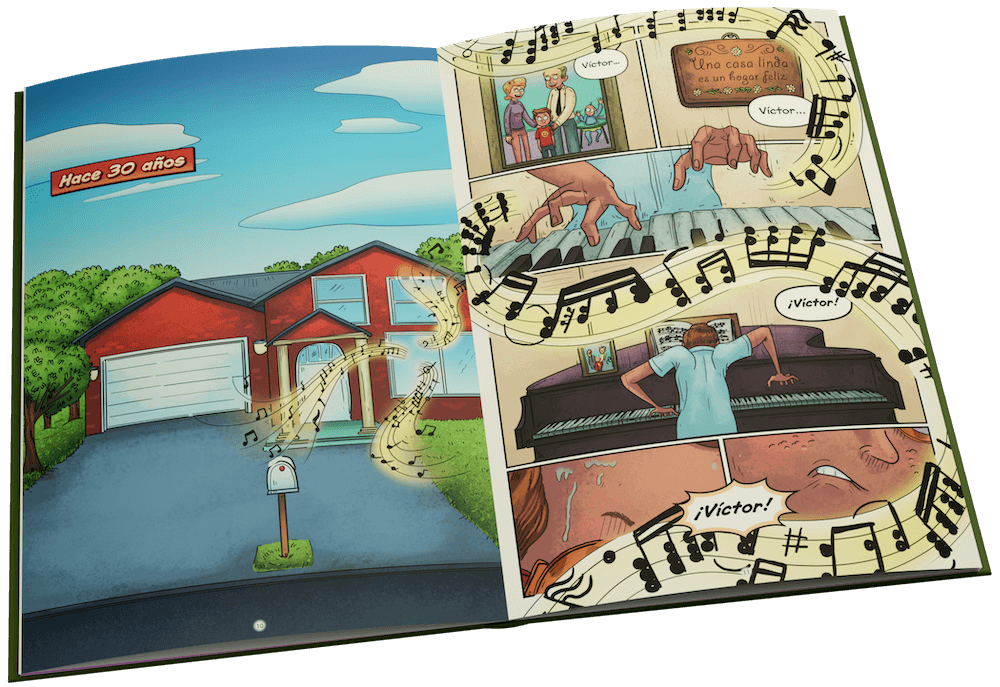
A two-page spread from Me llamo Víctor, Parte 1. Before you read every word, you already know quite a bit about what’s happening.
The basic idea
The pictures don’t replace the Spanish. They make it possible for students to keep reading when the Spanish gets difficult.
The story still has to be worth reading
Of course, none of this matters if students don’t care what happens next.
Visual support can help students understand a story. It can’t make them care about a boring one.
That’s one reason I’ve never thought of our graphic novels as vocabulary delivery systems. The goal isn’t to build a book around a predetermined list of words. The goal is to tell a story students actually want to finish, then make the Spanish comprehensible enough that they can.
That’s the same philosophy behind our music videos, too. I wrote more about why we put the story before the vocabulary here →

That idea has shaped everything we’ve made since
I originally wrote this post in 2019, when Juan Carlos Pinilla and I were deep into one of our most ambitious graphic-novel projects yet.
Since then, we’ve kept pushing the format. We’ve rewritten books for beginning readers, created stories at multiple proficiency levels, and built a digital reader with contextual glossaries, professional audio, and the option to read an entire page or focus on one panel at a time.
The tools have changed. The reason I love graphic novels hasn’t.
They give students more ways to understand the story without requiring us to remove all of the uncertainty from the language.


